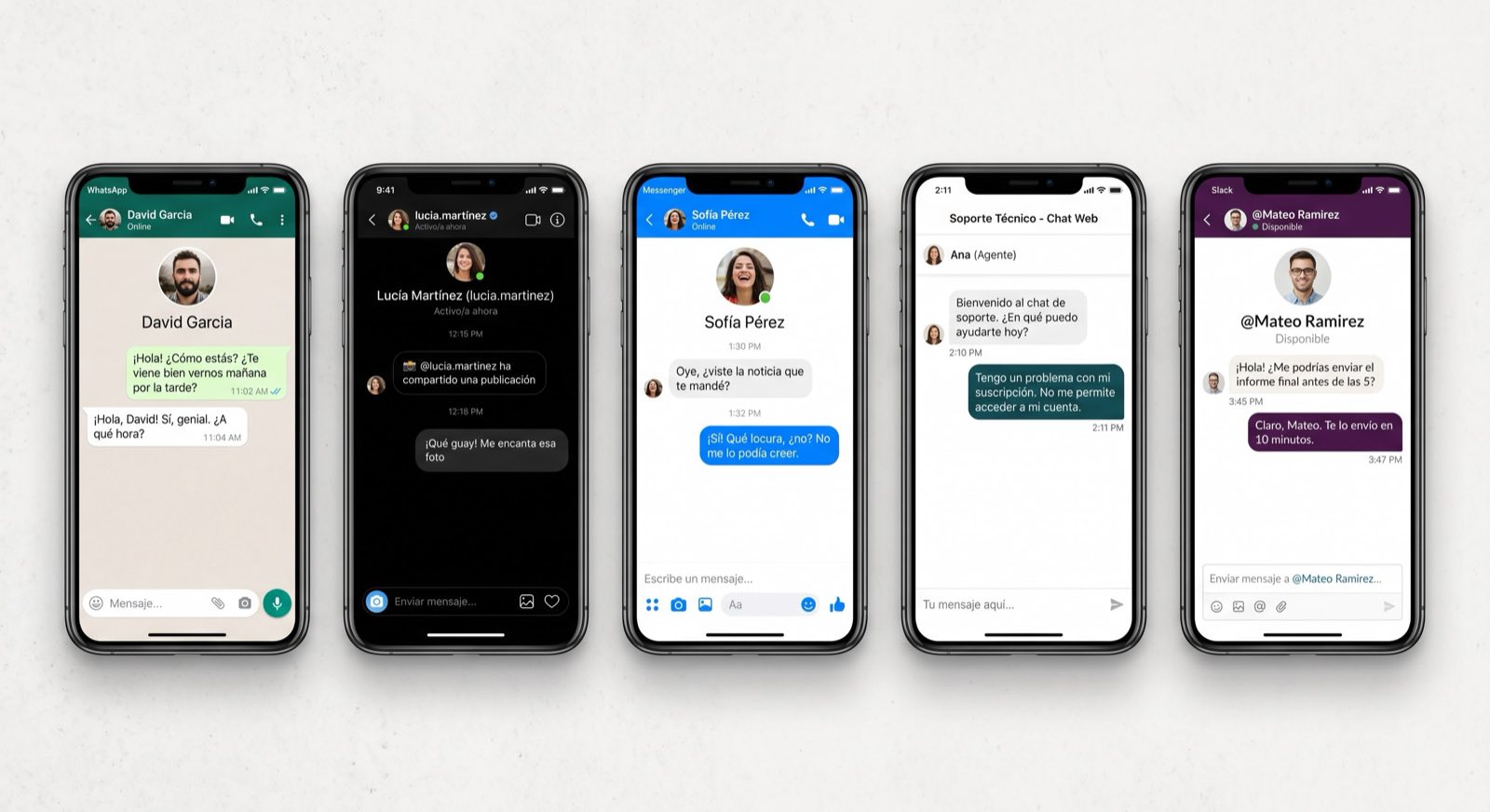
An AI chatbot for ecommerce is a conversational assistant that uses language models to understand natural-language questions and answer them with the real context of your catalog, shipping and policies. Unlike a rule-based bot, it does not follow a fixed tree: it understands intent, resolves the question, recommends and can close the sale in the same conversation, on WhatsApp, Instagram or the website chat.
Your commerce already thinks like an agent. Does your customer support?
More and more consumers turn to artificial intelligence to discover, compare and decide what to buy, while autonomous agents are starting to participate directly in the purchase process, not just to recommend products (McKinsey & Company, 2025, "The Agentic Commerce Opportunity").
If a business already runs on a composable architecture, with AI in the personalization, search and pricing layers, it is a step ahead of most. But there is a question almost no company modernizing its stack asks in time: who talks to the customer when they finally arrive?
Architecture determines how the experience is built. Support resolves what happens when someone has a real question, in real time. They are different layers, and many companies invest years in one while leaving the other exactly as it was a decade ago. That gap does not show up in the technical roadmap: it shows up in every conversation a customer abandons because no one answered in time. These are the signs it is already affecting sales.
1. Your commerce thinks in agents, but your support is still manual
Designing agentic commerce (flows an external system can read, quote and even buy from without human intervention) is one of the most sophisticated technical bets in digital commerce today. But if that same level of sophistication does not reach the channel where human customers write (WhatsApp, the website chat, Instagram), the investment in architecture does not translate into experience. It stays in the backend.
It is a common paradox: the system that automatically quotes a B2B buyer in seconds leaves a human buyer waiting fifteen minutes after a simple WhatsApp question. Technical sophistication and perceived experience end up misaligned, even though they share the same underlying platform.
2. You sell across several channels, but you support from separate inboxes
Shopify, VTEX, WooCommerce, Tienda Nube: each platform brings its own message panel, its own history, its own waiting queue. A customer who writes on Instagram and then on WhatsApp starts the conversation from scratch both times.
Centralizing channels is not an operational convenience. It is the difference between a customer who feels recognized and one who repeats their problem three times before someone resolves it. For an operation that sells to distributors, to end consumers and to its own direct brand, that fragmentation multiplies across every line of business: the team jumps between tabs while the customer, on the other side, only sees a slow reply.
3. Your AI agents generate data no one connects to the real conversation
A personalization engine knows which product to recommend. A conversational AI chatbot knows what to say when the customer asks why that product is the best option, resolves their shipping question and closes the sale right there.
When those two layers, the one that decides and the one that converses, do not share context, the customer notices the disconnect even without naming it: they get an accurate recommendation on the product page and, three minutes later, a generic answer when they ask about it over chat. That disconnect, multiplied by thousands of conversations a month, can turn into sales opportunities that are lost. Not for lack of intelligence in the system, but because that intelligence lives in a silo separate from the conversation.
4. Scaling support means hiring more people, not better technology
If every growth campaign means adding support agents to the team, the business is solving a technology problem with a payroll solution. That does not scale at the same pace as digital commerce growing 19.2% a year, as it does today in Mexico (AMVO, 2026, "Estudio de Venta Online 2026").
The cost is not only salary. It is also training time, team turnover and the inconsistency of tone that emerges when different people answer the same question differently.
5. Your customers expect an answer in seconds, not hours
A buyer who writes on a Tuesday at midnight expects the same as one who writes on a Sunday at noon: an answer now. 24/7 support has stopped being just a differentiator and is becoming an expectation of conversational commerce.
When a business has already invested in agentic architecture, intelligent search and dynamic pricing, leaving customer support as the only manual link in the chain is the easiest gap to close and, paradoxically, the one most often postponed.
The layer that connects architecture with conversation
In collaboration with Edgebound Labs, Wizybot can be integrated as a conversational layer in a modern ecommerce architecture. Wizybot is an AI chatbot and conversational CRM for ecommerce that resolves exactly this gap: the support layer that connects with the architecture already built, instead of competing with it.
It resolves 96% of queries without human intervention, in more than 90 languages, serving unlimited customers simultaneously on WhatsApp, Instagram, Messenger, web chat and comments, all from one place. It does not just answer: it recovers abandoned carts, recommends products and closes the sale in the same conversation, connecting directly with Shopify, VTEX, WooCommerce and Tienda Nube.
For a business that has already invested in agentic architecture, connecting that intelligence with the customer's real conversation can be the next step to bring that technology investment into the buying experience.
Try the conversational layer in your ecommerce
Book a Wizybot demo and compare the result with your current support, with a 100% refund guarantee in the first month if you do not notice the difference. Plans and pricing are available here.
Book a demo→Frequently asked questions
What is an AI chatbot for ecommerce?
It is a conversational assistant that uses language models to understand natural-language questions and answer them with the real context of your catalog, shipping and policies. Unlike a rule-based bot, it does not follow a fixed tree: it understands intent, resolves questions, recommends products and can close the sale in the same conversation, on channels like WhatsApp, Instagram or the website chat.
How is an AI chatbot different from a traditional rule-based chatbot?
A rule-based chatbot answers with predefined scripts and breaks when the customer leaves the option tree. An AI chatbot interprets real intent, keeps the conversation context and connects to the store's data (catalog, inventory, orders) to give specific, not generic, answers. The first automates questions; the second automates conversations.
Does an AI chatbot replace the customer support team?
It does not replace it, it frees it from the repetitive work. It resolves the bulk of frequent queries autonomously and escalates complex cases to a human agent with the context already loaded. The team moves from answering the same thing a thousand times to handling what really needs human judgment.
Which ecommerce platforms does an AI chatbot integrate with?
Modern AI chatbots connect with the region's leading platforms: Shopify, VTEX, WooCommerce and Tienda Nube, among others. The integration gives them real-time access to catalog, prices, inventory and order status, which is what lets them answer with real data rather than template responses.
Can an AI chatbot sell, not just answer?
Yes. Beyond resolving questions, it recovers abandoned carts, recommends products based on the conversation context and closes the purchase within the same chat. Support stops being a cost center and becomes a conversion channel.
How does an AI chatbot connect with an existing composable or agentic architecture?
As a conversational layer on top of the stack you already have. It integrates via API with your commerce platform and consumes the same intelligence your personalization, search and pricing already use, so the layer that decides and the layer that converses share context. It does not compete with the modern architecture: it connects it to the human customer. See also our AI Commerce page.
Sources
- McKinsey & Company (2025), "The Agentic Commerce Opportunity"
- AMVO (2026), "Estudio de Venta Online 2026" (digital commerce growth in Mexico, 19.2% per year)
- Wizybot (product, demo and pricing): wizybot.com