The ROI of artificial intelligence is the ratio between the net benefit an AI project generates and its total cost. The trap is in the numerator: the benefit is not just the money you save: it is also the revenue you generate, the time you free up, and the cost of standing still while your competitors move.
For years, technology investments were justified for one very simple reason: cutting costs.
Today, artificial intelligence has changed that logic. Companies no longer implement AI solely to automate tasks, but to improve the customer experience, accelerate decision-making, optimize operations, and create new business opportunities.
Yet one question keeps coming up in every executive committee: how do you know whether investing in AI is actually worth it?
The answer lies in understanding that the return on these projects goes far beyond cost savings. I am writing this from the finance side (the place where these investments get approved or rejected) and this is how they should be framed.
The most common mistake: measuring only how much money you save
When ROI comes up, many organizations think only about cutting expenses:
- Fewer administrative hours.
- Lower operational load.
- Fewer errors.
- Lower customer service costs.
While these benefits matter, they represent only part of the value an artificial intelligence project can generate. And they are also the part with a ceiling: savings have a natural limit, you cannot save more than 100% of a cost. Revenue has no such ceiling.
The formula, no fluff
The base calculation is the usual one:
The detail is in filling in both variables correctly. Total cost is not just the technology: it includes model licensing or consumption, implementation, integration with existing systems, maintenance, and team training. Net benefit adds up measurable savings and incremental revenue attributable to the project.
The second number every committee asks for is payback: the number of months it takes for the accumulated benefit to cover the investment. In well-scoped AI commerce projects (intelligent search, recommendations, support automation) a 3 to 6 month payback is a reasonable target when the use case is well chosen.
AI also generates revenue
A well-designed implementation can directly move commercial indicators:
- Higher conversion rate.
- Increased average order value through intelligent recommendations.
- Better personalization of the shopping experience.
- Higher customer retention.
- Recovery of abandoned sales.
- Customer service available 24/7.
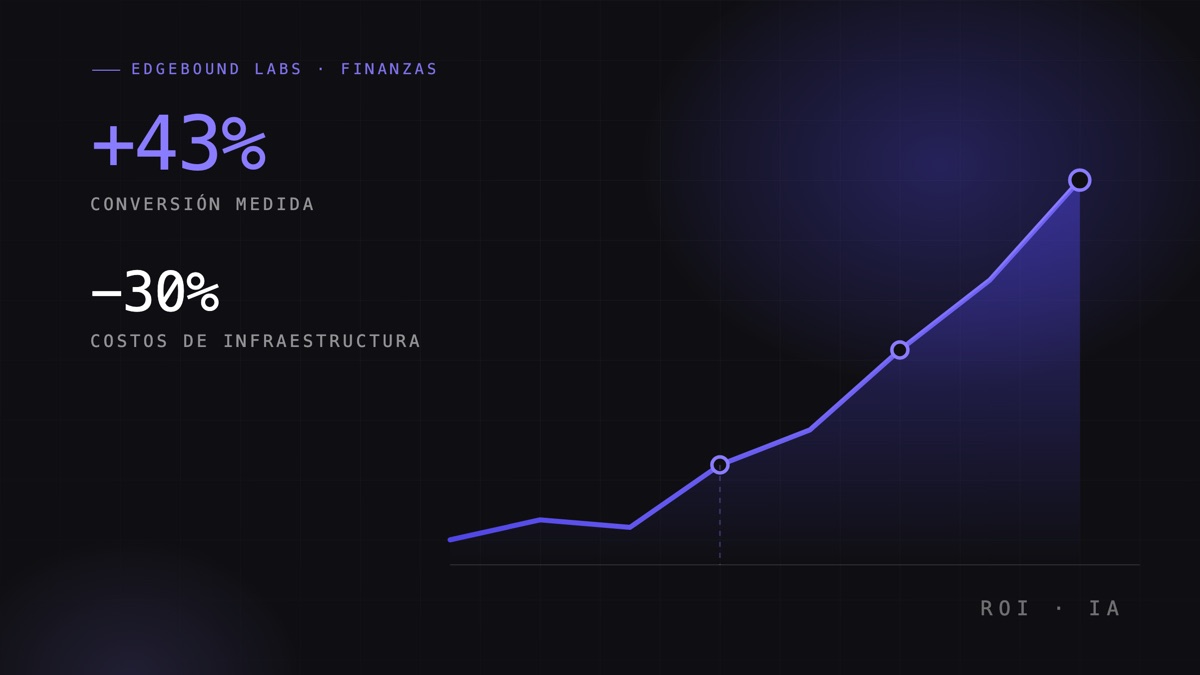
This is not theory. In projects where the lab has applied AI in a structured way, the measured average is a +43% improvement in conversion; and in well-executed migrations to MACH architecture, −30% in infrastructure costs (averages from real Edgebound Labs projects, 2023–2026).
In other words: AI does not just help you spend less. Implemented well, it helps you sell more, and that is the half of the ROI most business cases leave out.
ROI is also in the speed
One of the least visible benefits of AI is time. Automating processes lets teams spend fewer hours on repetitive tasks and more time on strategic work:
- Generating product descriptions.
- Classifying information.
- Answering frequently asked questions.
- Producing reports.
- Analyzing large volumes of data.
Speed has a concrete financial value even if it does not show up directly on the income statement: every hour freed from repetitive work is capacity you reinvest without hiring. Shorter execution times become a competitive advantage, especially in a market where speed makes the difference.
Which indicators should you measure?
Before starting any project, it is important to define which metrics you expect to improve, and to measure their baseline. Without a baseline, there is no way to prove the return afterward. Depending on the objective, these are the indicators worth putting on the table:
| Project objective | KPIs to measure | Where it shows up |
|---|---|---|
| Sell more | Conversion rate, average order value, cart recovery | Revenue |
| Operate at lower cost | Cost per interaction, administrative hours, error rate | Operating cost |
| Respond faster | Response time, cycle time of key processes | Productivity |
| Retain customers | Retention, repeat purchase, NPS/CSAT, returns | Recurring revenue |
When these metrics are set from the start (with their current value documented) proving the value generated by the investment becomes much simpler. It is the difference between "we think it worked" and "it improved 18% against the baseline".
Think about the cost of doing nothing
There is another variable few companies consider: not implementing AI also has a cost.
While a company keeps operating with manual processes, its competitors can:
- Respond faster.
- Personalize the experience better.
- Optimize inventory.
- Make decisions with more information.
- Offer better customer service.
And the window is moving fast: McKinsey & Company projects US$3 to 5 trillion in global agentic commerce by 2030: commerce where AI agents discover, compare, and buy. In many cases, the biggest risk is not investing in artificial intelligence: it is falling behind while the market changes the rules.
Conclusion
Artificial intelligence should not be seen as a technology trend, but as a tool for solving business problems.
The real return on investment is not limited to saving money. It also shows up in a better customer experience, more efficient operations, faster decisions, and sustainable growth.
That is how we work at the lab: experiment, measure against a baseline, and scale only what moves the needle.
Frequently asked questions about AI ROI
What is the ROI of artificial intelligence?
It is the ratio between the net benefit an AI project generates and its total cost of ownership. It is calculated as (net benefit − total cost) / total cost × 100, and includes both hard benefits (savings, incremental revenue) and soft ones (speed, customer experience, better decisions).
How do you calculate the ROI of an AI project?
ROI = (net benefit − total cost) / total cost × 100. Total cost must include model licensing or consumption, implementation, integration with existing systems, maintenance, and team training, not just the technology. Net benefit adds up measurable savings and incremental revenue attributable to the project.
How long does it take to recover an AI investment?
It depends on the use case. Well-scoped projects with clear metrics (AI-powered search, recommendations, support automation) typically show measurable results within the first 3 to 6 months. The key is defining the baseline before you start: without a baseline, there is no way to prove the return.
Which KPIs should you measure in an AI project?
The ones that match the project's objective: conversion rate and average order value if the goal is to sell more; cost per interaction and response time if it is operational efficiency; retention and satisfaction (NPS/CSAT) if it is customer experience. Defining them before you start is what makes the value provable.
What happens if my company does not invest in AI?
Not investing also has a cost: competitors that respond faster, personalize better, and decide with more information. McKinsey & Company projects US$3 to 5 trillion in global agentic commerce by 2030, the cost of falling behind grows every year.
How is the ROI of an AI project measured?
Against a baseline and a business KPI, not against features. You define the target metric (conversion, cost per order, response time), measure it before, implement, and measure the delta in production. A serious AI project is sized by its business impact, not by the number of models it uses.
Want to know if your operation is ready to generate ROI with AI?
Start with our free AI Readiness Check (2 minutes, no sign-up) or book a Discovery session: a diagnosis of your stack with success metrics defined from day one.